Social Communication Therapy for Children
Language is more than words and sentences—it is the tool children use to build relationships, navigate social situations, and understand the perspectives of others. For children with autism spectrum disorder (ASD), social (pragmatic) communication disorder, or other conditions that affect social interaction, the unwritten rules of communication can feel invisible and overwhelming.
At Front Range Speech in Greeley, Colorado, we provide specialized social-pragmatic language therapy that goes beyond surface-level social skills training. Our approach targets the underlying cognitive and linguistic processes that drive successful social interaction—perspective-taking, inferencing, flexible thinking, and real-time language formulation. Families throughout Northern Colorado, including Windsor, Evans, Loveland, Fort Collins, and Johnstown, rely on our clinic for expert intervention in this complex area.
What Is Pragmatic Language?
Pragmatic language encompasses the social rules that govern how we use language in context. While a child may have a strong vocabulary and produce grammatically correct sentences, pragmatic language difficulties affect how that language is used in real interactions. Core pragmatic skills include:
Conversational reciprocity — taking turns, staying on topic, recognizing when a conversation partner is losing interest, and repairing communication breakdowns
Perspective-taking — understanding that other people have thoughts, feelings, knowledge, and intentions that differ from your own (theory of mind)
Nonverbal communication — interpreting and using facial expressions, body language, gestures, tone of voice, and personal space
Contextual language adjustment — modifying how you speak based on the listener, setting, and purpose (talking to a teacher versus a friend, for example)
Nonliteral language comprehension — understanding sarcasm, idioms, humor, implied meaning, and indirect requests
Children who struggle with pragmatic language often appear socially awkward, overly literal, or disengaged—not because they lack intelligence or desire for connection, but because the social code that peers acquire implicitly requires explicit teaching for them.
Our Evidence-Based Approach
Effective social skills therapy requires more than just telling a child what to do. We use evidence-based methodologies that break down complex social interactions into concrete, teachable components.
Social Thinking Methodology
Social Thinking, developed by Michelle Garcia Winner, provides a metacognitive framework that helps children understand why social rules exist—not just what to do. Concepts like "thinking with your eyes," "expected and unexpected behaviors," and "the group plan" give children a concrete vocabulary for abstract social concepts. We use Social Thinking as a foundational framework and layer in additional strategies based on each child's needs.
Video Modeling
Video modeling is a highly effective technique for children on the autism spectrum. By watching video examples of target social behaviors—such as joining a group conversation, responding to a compliment, or handling a disagreement—children can observe, analyze, and rehearse skills in a low-pressure format before practicing them in real interactions. We use both commercially available video models and custom recordings tailored to your child's specific goals.
Social Stories & Visual Supports
Social stories, originally developed by Carol Gray, use short narratives to describe social situations, expected behaviors, and the perspectives of others involved. They are particularly effective for preparing children for new or challenging situations—a field trip, a birthday party, or a change in classroom routine. We create individualized social stories and pair them with visual supports that your child can reference at home and school.
Peer-Mediated Intervention
Social skills practiced only in a therapy room with an adult have limited transfer to real-world peer interactions. Peer-mediated intervention addresses this by involving trained peers as interaction partners during therapy activities. When appropriate, we structure opportunities for your child to practice target skills with age-matched peers, building confidence and generalization in a supported setting.
Naturalistic & Play-Based Strategies
For younger children, social communication intervention is most effective when embedded in natural play contexts. We use child-led play, structured social games, and collaborative activities to target joint attention, shared enjoyment, turn-taking, and early conversational skills. These naturalistic approaches ensure that therapy feels motivating rather than demanding, which is critical for engagement and long-term skill retention.
Who Benefits from Social-Pragmatic Therapy?
Social communication therapy at Front Range Speech serves children with a range of diagnoses and profiles, including:
What Therapy Looks Like in Practice
Every child's social communication profile is unique, and our therapy plans reflect that. Following a comprehensive evaluation, we identify your child's specific strengths and areas of need across pragmatic language domains. Goals might include initiating conversation with peers, recognizing facial expressions, understanding sarcasm, managing topic maintenance, or developing conflict resolution strategies.
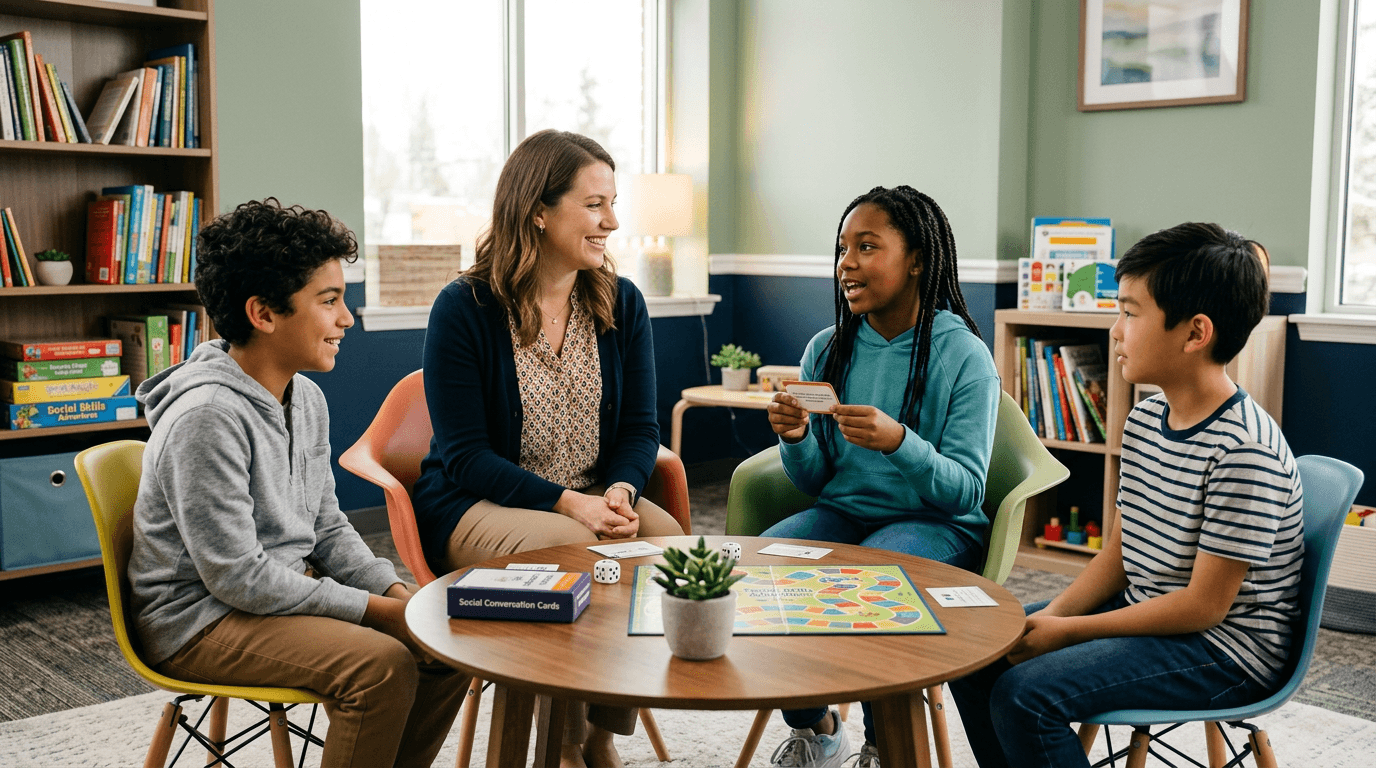
Sessions are active and interactive. A typical session might involve watching and discussing a video model, role-playing a social scenario, playing a structured game that requires negotiation and collaboration, and debriefing with your child about what worked and what they might do differently. We provide parents with specific strategies and activities to reinforce skills at home, because social learning happens in every interaction—not just during the therapy hour.
Collaboration with Families and Schools
Social communication challenges affect every setting a child enters. We work closely with parents to ensure that strategies used in therapy carry over to home routines, sibling interactions, and community activities. For school-aged children in Greeley, Evans, Windsor, and surrounding Weld County districts, we coordinate with teachers, school psychologists, and behavioral specialists to support IEP goals and classroom accommodations that promote social success.
Also exploring ADHD, dyslexia, or autism?
Many children who need social-pragmatic language support also have questions about attention, reading, or autism. We can screen communication here and refer for an autism evaluation or other psychological testing when that is the next step.
View screening and referralsIf your child is struggling to connect with peers, navigate conversations, or understand the social expectations around them, we encourage you to reach out. Social-pragmatic language therapy can give your child the tools to build the meaningful relationships they deserve. Contact Front Range Speech to schedule an evaluation for families in Greeley, Fort Collins, Loveland, and throughout Northern Colorado.
Looking for reading help? Reading & literacy support is available nationwide →