Giving Every Child a Voice
Every child deserves a reliable way to express their thoughts, make choices, ask questions, and connect with the people around them. For children whose speech is absent, limited, or difficult to understand, augmentative and alternative communication (AAC) provides that pathway. At Front Range Speech in Greeley, Colorado, we specialize in AAC evaluation, device selection, programming, and ongoing therapy to help children communicate as fully and independently as possible.
AAC is not a last resort—it is a bridge. Whether a child is preverbal, has a motor speech disorder that severely limits intelligibility, or uses some words but cannot yet meet all of their communication needs through speech alone, AAC provides access to language right now, during the critical years when vocabulary, grammar, and social communication are developing most rapidly.
What Is AAC?
Augmentative and alternative communication encompasses a broad spectrum of tools and strategies. "Augmentative" means supplementing existing speech; "alternative" means providing a primary means of communication when speech is not functional. AAC systems are generally categorized as:
Low-Tech AAC
Communication boards, picture exchange systems, core vocabulary boards, and PODD (Pragmatic Organisation Dynamic Display) communication books. These systems require no batteries or electronics and are highly portable and durable.
Mid-Tech AAC
Simple voice-output devices with pre-recorded messages, such as single-message switches and sequential message devices. These are often used as stepping stones or for specific communicative functions like requesting and greeting.
High-Tech AAC
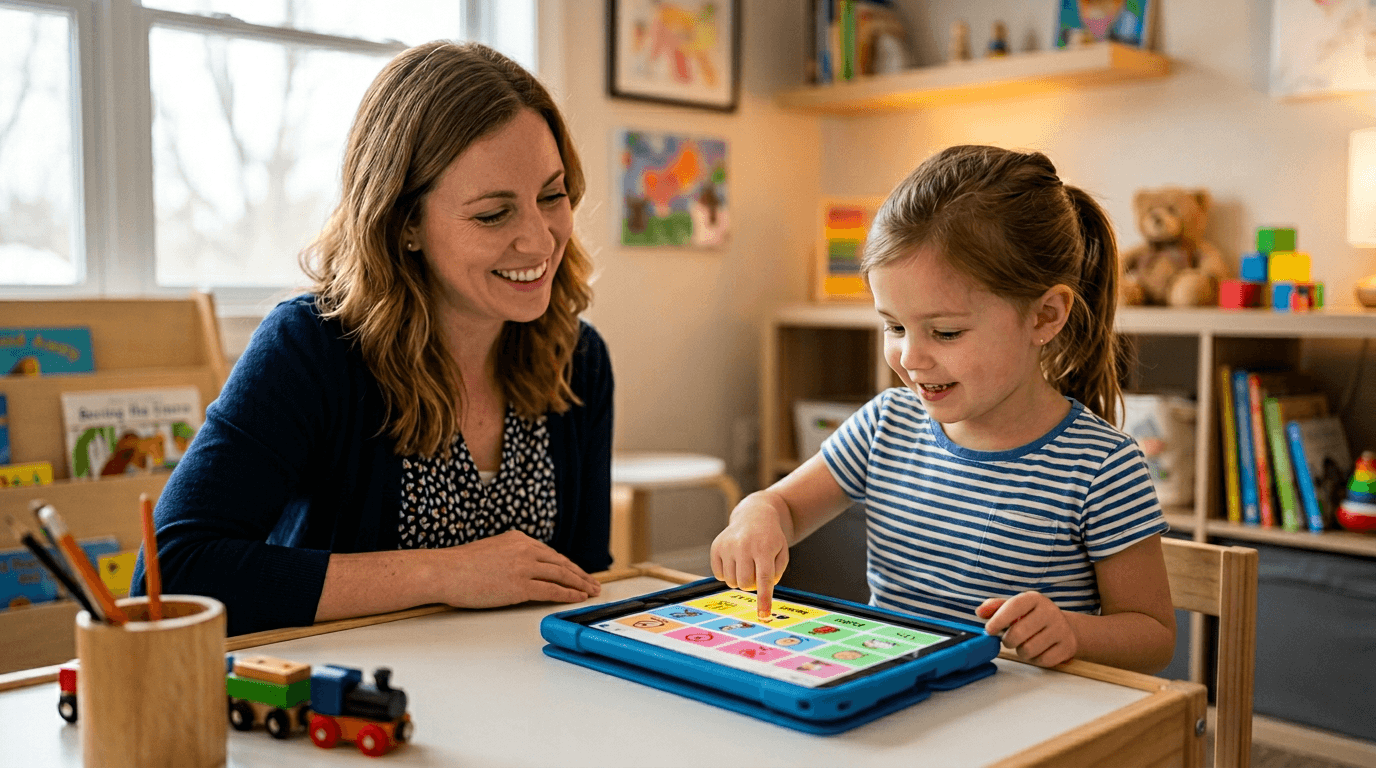
Speech-generating devices (SGDs) and tablet-based communication apps that produce synthesized or digitized speech. Examples include Proloquo2Go, TouchChat with WordPower, LAMP Words for Life, and dedicated devices such as the NOVA chat series. These systems offer robust vocabulary, grammatical flexibility, and the ability to communicate novel messages.
Our AAC Evaluation Process
Selecting the right AAC system is one of the most consequential clinical decisions in pediatric speech-language pathology. A device that is too complex will be abandoned; a device that is too simple will limit a child's ability to grow. At Front Range Speech, we use a systematic feature-matching approach to ensure the best possible fit.
Feature Matching
Feature matching is the process of aligning a child's motor, cognitive, linguistic, sensory, and communication profile with the features of available AAC systems. We assess how the child accesses the device (direct selection with a finger, eye gaze, head tracking, or switch scanning), the vocabulary organization system that best supports their language level, the symbol representation that is most meaningful to them, and practical considerations such as portability and durability.
Device Trials
Before making a recommendation, we conduct structured device trials in which the child has the opportunity to interact with multiple AAC systems during functional communication activities. We observe ease of access, speed of message generation, engagement, and the child's ability to learn the system's organizational structure. Device trials allow us to make data-driven recommendations rather than relying on assumptions about what a child "should" be able to use.
AAC Systems We Specialize In
Our clinicians have advanced training and hands-on experience with the AAC systems most commonly used in pediatric practice:
LAMP (Language Acquisition through Motor Planning)
A therapeutic approach paired with the Unity vocabulary system that emphasizes consistent motor patterns for word retrieval. LAMP is particularly effective for children who benefit from motor-based learning and need a system that supports both single-word and multi-word message generation.
Proloquo2Go
A widely used iPad-based AAC app with a Crescendo™ vocabulary that grows with the child. It offers extensive customization, natural-sounding voices, and a grid-based layout that supports core vocabulary access.
TouchChat with WordPower
A flexible AAC app available on iPad and dedicated devices, offering multiple page set options including WordPower, which uses a core-word-based organization with word prediction.
NOVA chat
A dedicated speech-generating device line from Saltillo that runs the TouchChat software on a durable, purpose-built hardware platform with built-in amplification and keyguard compatibility.
PODD
Pragmatic Organisation Dynamic Display is a communication book system designed by Gayle Porter that organizes vocabulary by communicative function, making it intuitive for communication partners to model and for children to navigate across a wide range of communicative contexts.
Therapy and Communication Partner Training
Obtaining an AAC device is only the first step. The true work begins with therapy and implementation. At Front Range Speech, our AAC therapy focuses on developing linguistic competence (learning the vocabulary and grammar of the device), operational competence (learning how to navigate the device efficiently), social competence (using the device for a variety of communicative functions like protesting, commenting, and asking questions), and strategic competence (repairing communication breakdowns).
Crucially, we place a heavy emphasis on communication partner training. A child will not learn to use an AAC device if they are the only person in the room using it. We train parents, caregivers, and educators in aided language stimulation—the practice of modeling language on the device while speaking. We teach families how to create communication opportunities throughout the day, how to respond to device use, and how to integrate AAC into daily routines like mealtime, playtime, and reading.
Insurance Funding and Device Acquisition
Dedicated speech-generating devices are often covered by Medicaid, private insurance, and other funding sources. The process of obtaining funding can be complex and time-consuming, involving detailed documentation, letters of medical necessity, and device justification. Front Range Speech assists families throughout this process—from the initial evaluation report through device ordering and delivery—to ensure that financial barriers do not prevent a child from accessing the communication system they need.
Also exploring ADHD, autism, or dyslexia?
Many children who may benefit from AAC also have broader developmental questions. We can move forward with communication support now, screen attention and reading, and refer for an autism evaluation or other psychological testing when that is needed.
View screening and referralsServing Greeley and Northern Colorado
Our Greeley clinic at 4645 18th St, Ste #200, Greeley, CO 80634 provides AAC services to families across Northern Colorado, including Fort Collins, Loveland, Windsor, Evans, Johnstown, Milliken, and surrounding communities. Whether your child is just beginning to explore AAC or already has a device that needs updated programming and expanded vocabulary, Front Range Speech offers the specialized expertise to help your child communicate with confidence and independence.
Looking for reading help? Reading & literacy support is available nationwide →