The Speech-Language Pathology Approach to Reading
Reading is not a visual skill—it is a language skill. Decades of research in developmental psycholinguistics and cognitive neuroscience have established that reading depends on a child's ability to process the sound structure of spoken language, map those sounds onto printed letters, and draw on vocabulary, grammar, and world knowledge to construct meaning from text. When children struggle to read, the underlying cause is almost always a weakness in one or more of these language systems—not a problem with vision, intelligence, or effort.
Our speech-language pathologists bring a deep understanding of phonological processing, morphological awareness, and language comprehension to reading intervention — delivered nationwide via secure telehealth. This clinical expertise allows us to identify exactly where a child's reading process breaks down and to design therapy that targets the root cause rather than the surface symptom.
Why an SLP for Reading Difficulties?
The American Speech-Language-Hearing Association (ASHA) has affirmed that literacy falls squarely within the speech-language pathologist's scope of practice. SLPs are trained to assess and treat the phonological, semantic, syntactic, and discourse-level language skills that underlie reading and writing. This is a critical distinction: while reading tutors and classroom interventions often focus on practicing reading behaviors—guided oral reading, leveled texts, comprehension worksheets—an SLP targets the cognitive-linguistic processes that those behaviors depend on.
For children with dyslexia, the core deficit is phonological processing—the ability to perceive, store, and retrieve the sound patterns of language. An SLP does not simply teach phonics rules; we systematically build the auditory-linguistic representations that make phonics instruction meaningful. For children with reading comprehension difficulties, the breakdown often lies in vocabulary depth, syntactic understanding, or inferential reasoning—areas that SLPs are uniquely qualified to address.
Furthermore, children with a history of speech sound disorders or language delays are at significantly higher risk for reading difficulties. Research indicates that up to 50% of children with preschool language delays will experience reading problems in elementary school. An SLP can monitor this risk, provide early intervention, and ensure a seamless transition from oral language goals to written language goals as the child enters school.
How Online Reading Therapy Works
Families anywhere in the United States can access language-based reading intervention through secure video sessions. Our telehealth model is designed for school-age children who need specialized SLP reading support — not generic tutoring.
1. Initial Telehealth Evaluation
We assess phonological awareness, decoding, fluency, vocabulary, and comprehension to pinpoint where reading breaks down.
2. Individualized Treatment Plan
Based on evaluation results, we build a targeted plan addressing the specific language and phonological deficits affecting your child's reading.
3. Weekly Video Sessions
Structured, explicit therapy sessions delivered via secure telehealth — systematic, cumulative, and aligned with the Science of Reading.
4. Parent Coaching
Parents receive clear guidance on supporting literacy development between sessions, including decodable text selection and home practice strategies.
Who This Is For
Our nationwide reading program is ideal for school-age children who struggle with decoding, dyslexia, poor spelling, reading comprehension, or a history of speech and language delays. If tutoring or classroom intervention has not produced lasting gains, an SLP-led approach may address the underlying language processing weaknesses.
Our Areas of Focus
Our reading and literacy intervention program addresses the full spectrum of language skills required for reading and writing success. We provide comprehensive evaluation and targeted therapy in the following areas:
Phonological Awareness
The ability to hear and manipulate the sound structure of spoken language. We target rhyming, syllable blending, phoneme isolation, segmentation, and manipulation—the essential prerequisites for decoding and spelling.
Decoding and Phonics
The ability to apply letter-sound correspondences to read unfamiliar words accurately and efficiently. We use structured, explicit, and multisensory approaches to build the alphabetic principle and orthographic mapping.
Reading Fluency
The ability to read text accurately, at an appropriate rate, and with proper expression (prosody). Fluency bridges the gap between word recognition and comprehension.
Vocabulary and Morphology
Understanding the meaning of words and the smallest units of meaning within words (prefixes, suffixes, roots). Morphological awareness is crucial for decoding multisyllabic words and expanding academic vocabulary.
Reading Comprehension
The ability to understand, interpret, and integrate information from text. We target syntactic comprehension, inferencing, summarizing, and understanding narrative and expository text structures.
Written Expression
The ability to formulate ideas and translate them into written text. We address sentence formulation, paragraph organization, spelling, and the planning and revision processes required for writing.
The Simple View of Reading
Our intervention framework is guided by the Simple View of Reading, a widely accepted scientific model proposing that reading comprehension is the product of two distinct but equally important components: Decoding (word recognition) and Linguistic Comprehension (understanding spoken language).
If a child has strong language comprehension but poor decoding skills (as is typical in dyslexia), reading comprehension will suffer because the child cannot access the words on the page. Conversely, if a child has strong decoding skills but poor language comprehension (often seen in Developmental Language Disorder or hyperlexia), they may read a passage fluently but fail to understand its meaning. If both areas are weak, the child faces a mixed reading difficulty.
Our comprehensive evaluations assess both decoding and linguistic comprehension independently, allowing us to pinpoint the specific source of the reading breakdown and tailor our intervention accordingly.
Our Evaluation Process
A thorough reading and literacy evaluation at Front Range Speech goes beyond simply determining a child's reading level. We conduct a detailed analysis of the underlying cognitive-linguistic skills that support reading. Depending on the child's age and presenting concerns, our evaluation may include:
- Standardized assessment of phonological and phonemic awareness
- Analysis of decoding skills (real and nonsense words) and spelling patterns
- Assessment of oral reading fluency (accuracy, rate, and prosody)
- Evaluation of receptive and expressive vocabulary, including morphological knowledge
- Assessment of listening comprehension and reading comprehension
- Analysis of narrative language skills and written expression
- Review of educational history, previous interventions, and IEP/504 plans
Following the evaluation, we provide a comprehensive written report detailing the child's strengths, areas of need, and specific recommendations for therapy and classroom accommodations.
Evidence-Based Intervention Strategies
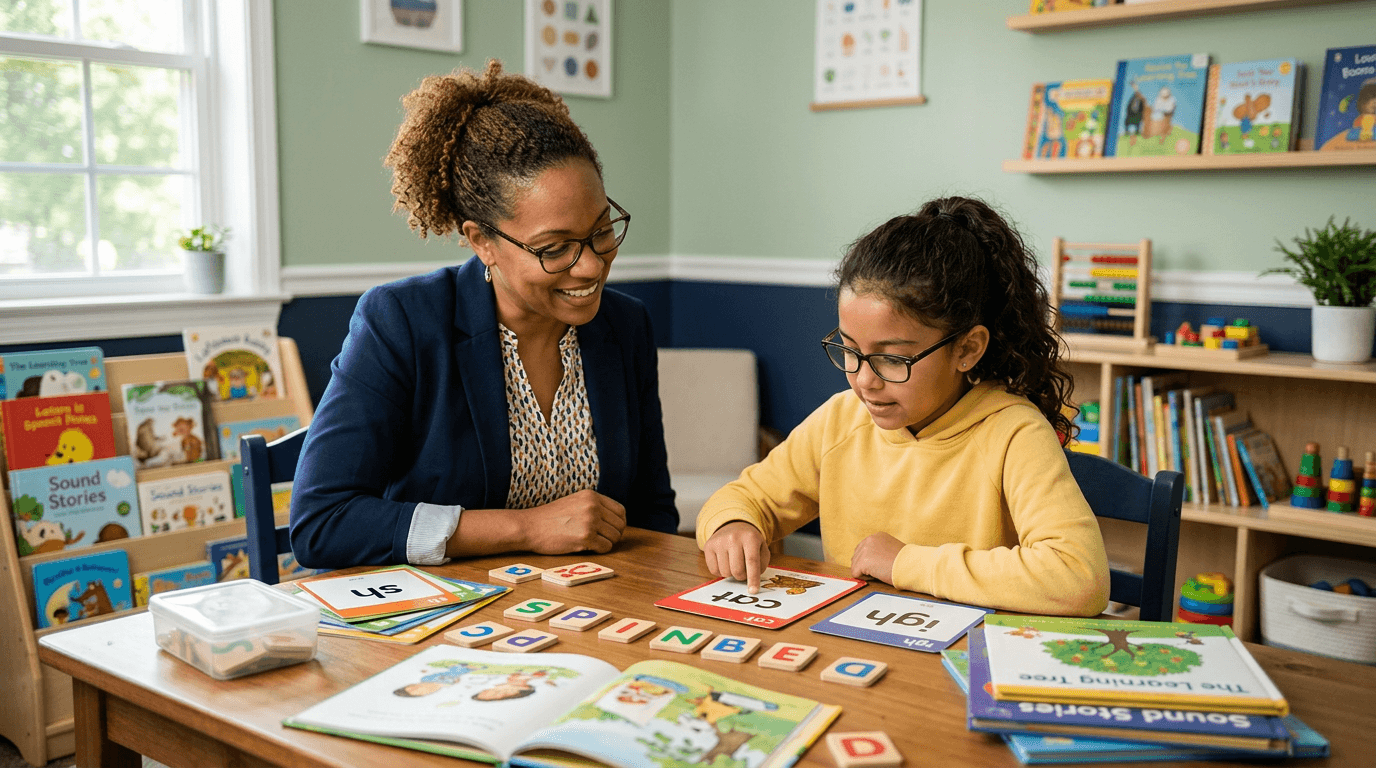
Our therapy sessions are structured, explicit, and individualized. We draw on evidence-based methodologies aligned with the Science of Reading, ensuring that intervention is systematic and cumulative. Key components of our approach include:
Explicit Instruction
We do not leave learning to chance. We explicitly teach phoneme-grapheme correspondences, spelling rules, morphological structures, and comprehension strategies, providing clear explanations and guided practice.
Multisensory Techniques
We engage multiple sensory pathways—auditory, visual, and kinesthetic-tactile—to reinforce learning and build strong neural connections between sounds and letters.
Systematic and Cumulative Scope and Sequence
Therapy follows a logical progression, starting with the simplest concepts and gradually introducing more complex skills. New learning continually builds upon and reviews previously mastered material.
Data-Driven Decision Making
We continuously monitor progress and adjust our intervention based on the child's response to therapy, ensuring that we are targeting the right skills at the right pace.
Collaboration with Schools and Families
Reading difficulties impact every aspect of a child's educational experience. We collaborate with parents and, when families provide consent, with teachers and school teams to align therapy goals with classroom supports and IEP or 504 plans.
We also provide parents with the knowledge and tools they need to support their child's literacy development at home, from selecting appropriate decodable texts to reinforcing phonological awareness skills during everyday activities. Front Range Speech Therapy also offers in-person pediatric speech therapy at our Greeley, Colorado clinic for families within about 20 miles.