Speech Therapy for Children with Hearing Loss
A diagnosis of hearing loss changes the trajectory of a child's communication development—but with the right intervention, children who are deaf or hard of hearing can achieve spoken language outcomes on par with their hearing peers. At Front Range Speech in Greeley, Colorado, we provide specialized speech-language therapy for children with all types and degrees of hearing loss, from mild unilateral loss to profound bilateral deafness.
Whether your child uses cochlear implants, hearing aids, bone-anchored hearing aids (BAHAs), or a combination of devices, our therapy is built around the listening and spoken language (LSL) framework—an evidence-based model that prioritizes auditory brain development and spoken communication. Families throughout Northern Colorado, including Windsor, Evans, Loveland, Fort Collins, and Longmont, trust our clinic for expert-level hearing loss intervention.
Our Approach: Auditory-Verbal Therapy and Beyond
Auditory-verbal therapy (AVT) is the cornerstone of our practice for children with hearing loss. AVT is a diagnostic, parent-centered approach that teaches children to use their residual hearing and amplification technology to develop spoken language. Rather than relying on visual cues such as lip reading, AVT builds the auditory neural pathways that allow a child to learn language through listening.
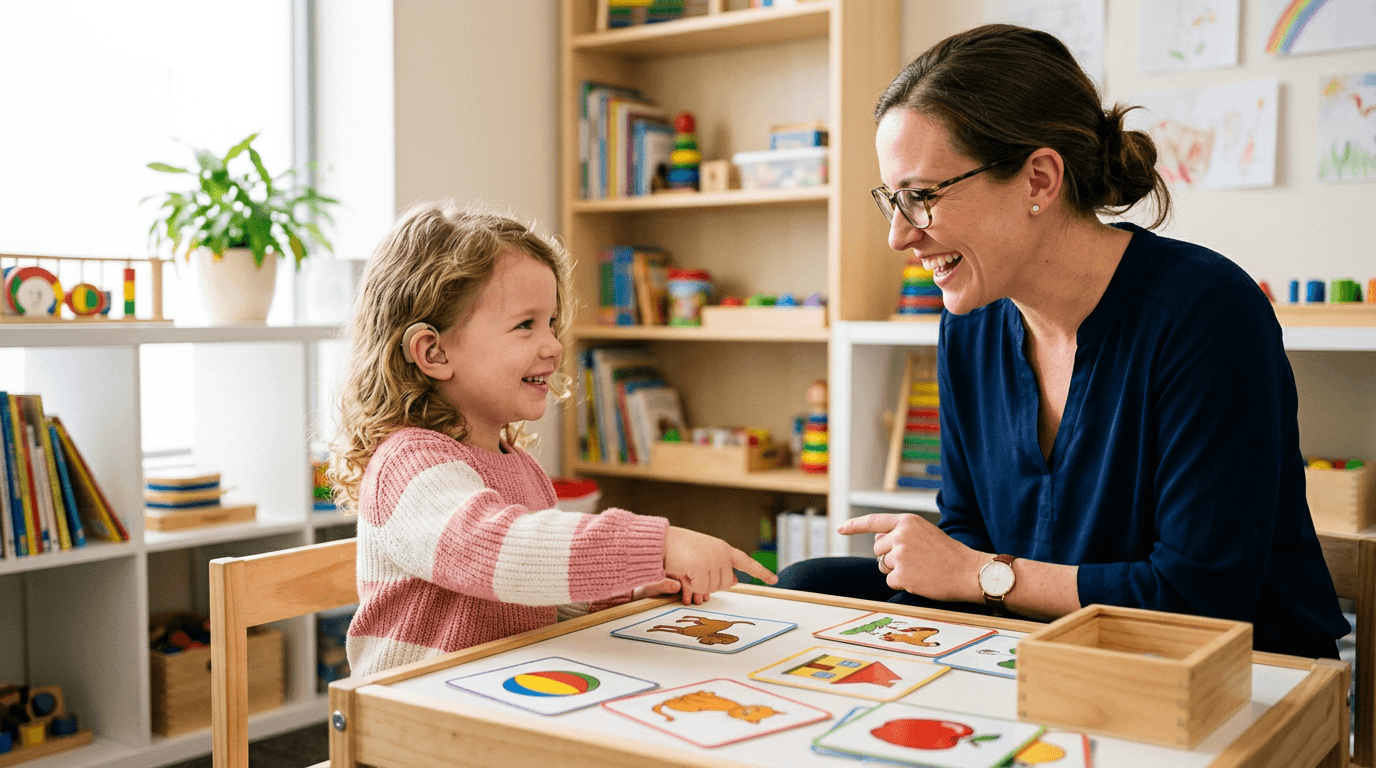
Each session follows a structured yet flexible format. We assess your child's current auditory skill level across the auditory hierarchy—detection, discrimination, identification, and comprehension—and design activities that push development to the next stage. Simultaneously, we coach parents and caregivers in real time, demonstrating techniques they can embed into everyday routines at home.
For families who prefer an auditory-oral approach that incorporates some visual information alongside auditory input, we adapt our methods accordingly. The goal is always the same: functional, intelligible spoken communication that allows your child to participate fully in academic and social settings.
Specialized Therapy by Device Type
Cochlear Implant Rehabilitation
Cochlear implants provide access to sound, but the brain must learn how to interpret that electrical signal as meaningful speech. We provide intensive post-activation therapy, beginning as soon as the device is turned on.
We work closely with your child's audiologist and CI team, providing detailed feedback on auditory responses to ensure therapy targets align with their mapping settings.
Therapy targets for children with cochlear implants typically include Ling sound detection and identification, suprasegmental pattern perception (rhythm, stress, intonation), vowel and consonant discrimination, word-level recognition in quiet and noise, and connected speech comprehension. As auditory skills develop, we layer in expressive language goals such as vocabulary, morphology, syntax, and narrative skills so listening gains translate into meaningful communication.
Hearing Aid & BAHA Therapy
Even with optimal amplification, children with hearing aids often miss subtle acoustic cues—like plural 's' markers or unvoiced consonants—that impact language development and literacy.
Our therapy focuses on closing the gap between a child's chronological age and their listening age, ensuring they develop the vocabulary, syntax, and speech clarity needed for academic success.
What We Target in Hearing Loss Therapy
Collaboration with Audiologists and Schools
Effective hearing loss intervention does not happen in isolation. We maintain active communication with your child's audiologist, ENT, early intervention team, and school-based professionals. In Greeley and the surrounding Weld County communities, we regularly coordinate with local school districts to support IEP and 504 plan development, recommend classroom accommodations such as FM systems and preferential seating, and ensure that therapy goals carry over into the academic environment.
For families receiving early intervention services through Colorado's Part C program, we can serve as the speech-language provider on your child's IFSP team, delivering services in the home or clinic setting depending on your family's needs.
Why Choose Front Range Speech for Hearing Loss Therapy
Pediatric hearing loss requires a speech-language pathologist with specialized knowledge that goes well beyond a generalist caseload. Our clinician brings advanced training in auditory-verbal therapy, cochlear implant rehabilitation, and the acoustic phonetics of aided hearing. We understand the nuances of different hearing technology, the implications of audiogram configurations on speech perception, and the developmental benchmarks that children with hearing loss should be meeting at each stage.
If your child has recently been identified with hearing loss, has received a cochlear implant or hearing aid, or is not making expected progress with their current therapy, we invite you to schedule a consultation. Families in Greeley, Fort Collins, Loveland, Windsor, and throughout Northern Colorado can reach us to discuss how we can support your child's listening and spoken language journey.
Looking for reading help? Reading & literacy support is available nationwide →